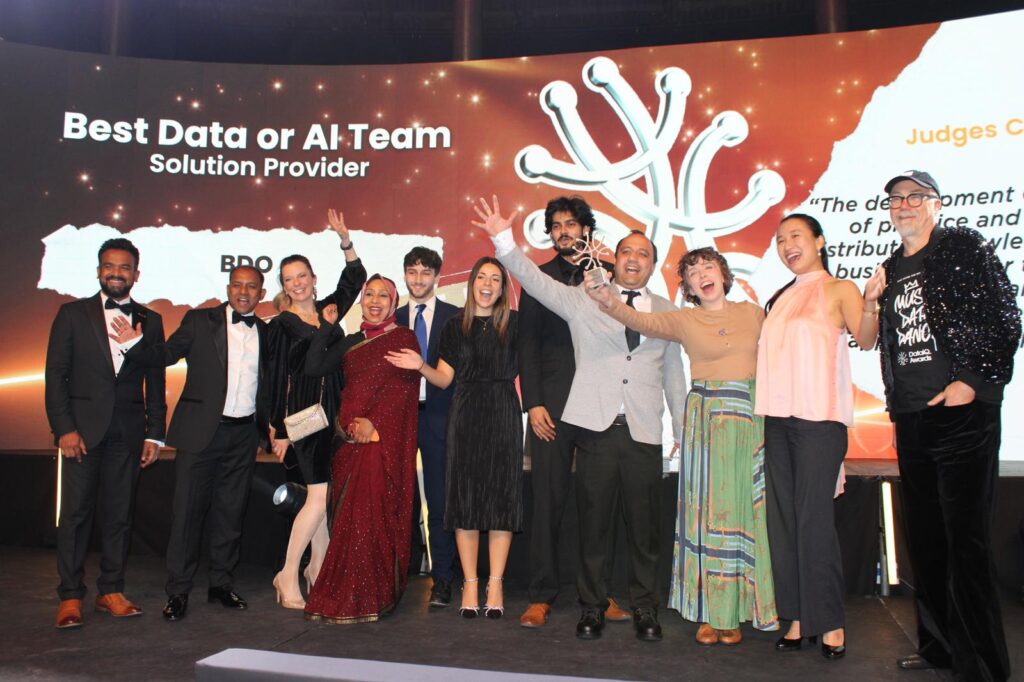
In just two-and-a-half years, BDO’s Data Office has grown from one to 16 specialists and created huge influence. Its 26 strategic data products generate £15.4 million in annualised ROI, while distributed governance and an 850-plus-member community are helping embed data ownership and capability across an 8,000-person firm.
How does a team of 16 transform the way an organisation of 8,000 people uses data? For BDO’s Data Office, the answer has been to avoid making transformation the responsibility of the central data team alone.
Since starting with a single person in July 2023, the Data Office has grown to 16 specialists spanning Data Governance, Data Analytics & Engineering, and Data Strategy. Alongside building its own capabilities, it has established networks of trustees, stewards, champions, product users, and community members.
Turning Data into Business Value
The Data Analytics & Engineering team has developed 26 strategic data products, now used daily by more than 3,000 colleagues. Collectively, those products generate an annualised ROI of £15.4 million.
One example is the Growth Hub dashboard, which has been embedded into partner review cycles and business development workflows. It has attracted 618 unique users, 4,365 report opens, and more than 6,800 views.
BDO keeps emphasis on embedding products into existing workflows. Rather than assuming that producing a dashboard will result in adoption, the team works with areas including Business Development, Audit, and operational leadership to connect data products directly to business processes.
“The development of data communities of practice and the emphasis on distributing knowledge across the wider business, rather than centralising it within a single team, is well articulated and demonstrates a strong, scalable approach to capability building.” – Judges’ comments
Scaling Through Distributed Ownership
The same principle underpins BDO’s approach to governance. With only two people in its core governance team, centralised ownership would have been difficult to scale. Instead, BDO established a distributed model involving seven Data Trustees and 40 Data Stewards.
The model has moved the business from having no formal data quality process to an established Data Quality Improvement Lifecycle. Ninety data quality issues have been logged and addressed, while annual remediation activity has doubled.
Based on leverage, the central team creates the framework and consistency, while responsibility for improving data extends into the business.
Building a Community Around Data
BDO has applied that philosophy to culture and capability. Its Data Community of Practice has grown to more than 850 members, making it one of the largest communities in the business. Twelve learning sessions attracted more than 1,700 attendees, while regional roadshows across seven offices reached more than 1,000 colleagues.
Other indicators of participation include:
- 400 enrolments in Data Core Skills training.
- 22,000+ views across 24 data-focused Viva Engage posts.
- 220 attendees at Inside BDO’s Data Future.
- 118 colleagues participating in peer-to-peer coffee networking.
Elsewhere, Data Success Stories, an idea proposed by a Data Champion, gives teams a way to share examples of effective data use and encourage others to replicate them.
Small Team, Enterprise Reach
The Data Office’s diversity contributes to its ability to work across the organisation. The team has a strong gender balance and collectively speaks more than 15 languages, bringing different cultural and professional perspectives. What distinguishes BDO’s approach is not what its 16 specialists have delivered themselves, but the network they have created around them.
In two-and-a-half years, the team has combined £15.4 million in annualised product ROI with formalised governance, distributed accountability, and an 850-plus-member data community.
This demonstrates an important principle for data leaders facing capacity constraints that enterprise transformation does not always require an enterprise-sized central team. By giving others the tools, structures, knowledge, and ownership to participate, BDO’s Data Office has multiplied its impact far beyond its own headcount.