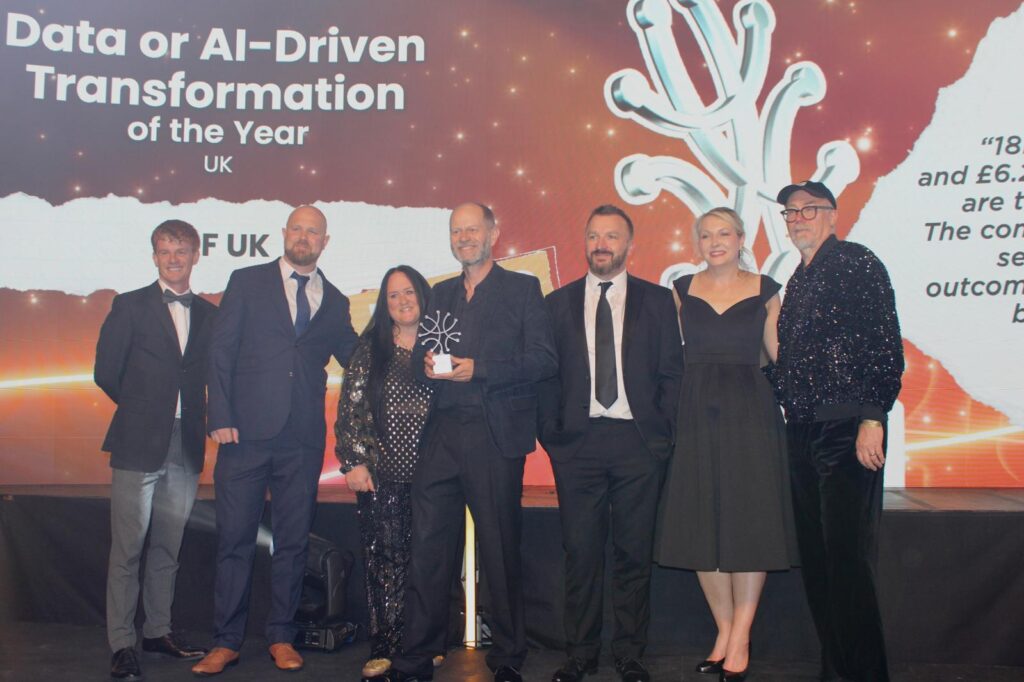
EDF transformed Sunday Saver from an AI-driven flexibility proposition into a blueprint for operationalising data, ML, and GenAI at scale. With nearly one million customer opt-ins, around 18 million hours of free electricity delivered, and £6.2 million in cost avoidance, the programme shows how AI can simultaneously support customers, frontline operations, and progress towards Net Zero.
The energy transition for Net Zero requires more than generating cleaner power. As electrification increases demand, encouraging customers to change when they consume electricity helps reduce pressure during peak periods and support a more flexible energy system.
EDF’s Sunday Saver was designed around this challenge, offering customers up to 16 hours of free electricity on Sundays in return for shifting consumption away from weekday peaks.
What began as an AI-driven participation and forecasting platform has since evolved into a broader transformation, combining production-grade ML with a GenAI capability embedded directly into frontline operations.
Taking AI from Analytics into Operations
Sunday Saver relies on half-hourly smart meter data to understand behavioural change, predict participation, and manage financial exposure. As adoption increased, EDF needed these capabilities to operate reliably at national scale rather than remain dependent on experimental or analyst-led processes.
Smart meter, customer, and scheme data were centralised, establishing a governed source of truth. Participation analytics and forecasting models were deployed using MLOps controls, making outputs repeatable, traceable, and auditable.
Scaling the proposition also created a new frontline challenge. Contact centre agents needed to answer increasingly complex questions covering eligibility, rewards, consumption patterns, and scheme rules. Manual interpretation and fragmented information risked creating inconsistency as customer numbers grew.
EDF responded by introducing a natural-language Q&A capability, enabling agents to query trusted enterprise data in real time. GenAI was embedded within existing governance frameworks, helping maintain control, explainability, and alignment with official scheme rules.
“18M hours of free electricity and £6.2M in customer cost avoidance are tangible, relatable numbers. The combination of MLOps and GenAI serving a genuine Net Zero outcome gives this entry real purpose beyond efficiency gains.” – Judges’ comments
Delivering Impact at National Scale
The transformation has produced measurable customer, commercial, operational, and environmental outcomes.
- Nearly one million customer opt-ins to Sunday Saver.
- Approximately 250,000 active customers.
- Around 18 million hours of free electricity delivered.
- £6.2 million in cost avoidance generated to date.
- AI-driven analysis of half-hourly smart meter data used to measure and encourage peak-shifting behaviour.
- Productionised forecasting supporting financial exposure management at scale.
- GenAI giving contact centre agents real-time access to trusted information.
- Improved first-contact resolution for Sunday Saver queries, with less reliance on escalation and manual interpretation.
The operational impact is significant because two forms of AI are working together. Machine learning operates behind the customer proposition, forecasting behaviour and supporting commercial decisions, while GenAI provides a natural-language interface between governed data and frontline employees.
Creating a Blueprint for Enterprise AI
Sunday Saver represents a change in how EDF approaches AI transformation. Data scientists, engineers, product owners, and business teams worked together to align technology with governance and operational requirements. Models have moved into business-as-usual processes, while GenAI has progressed from experimentation to a governed frontline workflow.
The environmental dimension adds another layer to the transformation. By incentivising customers to shift consumption away from peak periods, Sunday Saver supports more efficient use of the electricity system and EDF’s wider decarbonisation objectives.
The result is more than a successful flexibility proposition. Sunday Saver demonstrates how a modern data platform can connect established machine learning with newer generative capabilities while retaining the governance required for enterprise deployment.
By combining behavioural data, production-grade analytics, and trusted GenAI within one customer-facing proposition, EDF has created a repeatable model for moving AI beyond individual use cases and embedding it into the way an organisation operates securely, responsibly, and at scale.