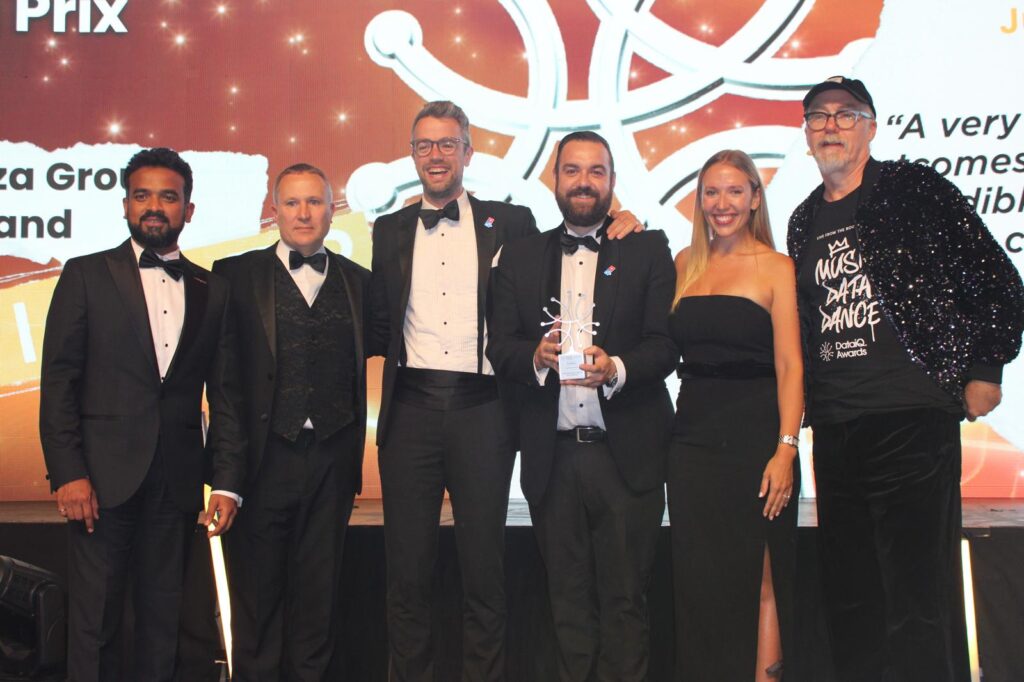
The Grand Prix is presented to the submission that scored highest across all the judges, which has been won in 2026 by Domino’s Pizza Group UK & Ireland for its submission to the Breakthrough With Data or AI – UK category.
What began as one data scientist’s unfunded idea has transformed how Domino’s measures, manages, and talks about the quality of its core product. Domi Vision has scored more than 3.2 million pizzas, driven a 5% improvement in quality, and identified a £3 million annual revenue opportunity while running for less than £20 a day.
Domi Vision’s origins make its achievements remarkable, coupled with the scale of the transformation and the high praise from judges is why Domino’s Pizza Group UK & Ireland has been named the Grand Prix Award winner at the 2026 DataIQ Awards.
Domi Vision started with no budget, no dedicated team, and just eight months to turn an idea into a production system capable of changing behaviour across one of the UK and Ireland’s largest franchise networks.
The in-house computer vision system has replaced a fragmented, subjective approach to pizza quality with consistent, AI-powered measurement. More importantly, it has turned quality from an occasional audit exercise into a daily operational priority across hundreds of stores.
Turning 0.01% Measurement into Continuous Insight
Domino’s serves more than 114 million pizzas annually across 1,400 stores operated by 61 franchisees. Yet, before Domi Vision, each store had only nine pizzas formally assessed every year: approximately 0.01% of its output.
Monitoring between audits varied considerably, while assessments themselves were subjective. Domino’s lacked a consistent, scalable view of the quality of its flagship product.
Domi Vision changed the model completely. Bespoke computer vision models, built and trained in-house, autonomously score pizzas using existing store cameras, creating a consistent benchmark and immediate feedback loop.
Rather than pursuing generative AI because of market momentum, Domino’s selected traditional machine learning for a specific operational problem, creating a lightweight system running on Databricks for less than £20 per day across the estate.
“This deserves a medal!”
“A brilliant, triumphant entry that captures the true spirit of a breakthrough.”
“Real impact by changing the culture of the company.” – Judges’ comments
From Resistance to Ownership
Before rollout, three franchise groups representing more than 400 stores opposed the initiative, concerned about how imagery and quality data might ultimately be used.
Domino’s paused the rollout rather than forcing adoption. Franchisees were invited to interrogate the scoring, compare results against their own expertise, and understand the boundaries around data use. A voluntary model was introduced, allowing franchise groups to opt in, and to leave at any time.
All three groups that initially opposed Domi Vision subsequently became active advocates with measurable results:
- More than 3.2 million pizzas scored since launch.
- Domi Vision deployed across 800 stores.
- Product quality improved by 5%.
- Quality-related customer sentiment increased by more than 1% year on year.
- An estimated £3 million annual revenue opportunity, now referenced in 2027 strategic planning.
- Operating costs of less than £20 per day.
- Domi Vision became Domino’s most-viewed Tableau report, 8% ahead of the next closest.
When Data Changes Culture
Store teams began sharing scores and examples of high-quality pizzas through WhatsApp groups. Franchisees requested league tables and anonymised rankings. Domi Vision pins emerged as badges recognising excellent pizza quality. Conversations increasingly focused on “bubble counts” and “crust consistency”, and quality became a primary KPI alongside delivery time.
“In 20 years, this is the most exciting thing I’ve seen at Domino’s,” said one senior leader.
The system is expanding beyond quality measurement. Planned developments include topping recognition to identify allergen risks and incorrect order construction, real-time intervention, monitoring during preparation, and tracking packing stations to improve order fulfilment.
Domi Vision demonstrates that transformative AI does not require enormous budgets, large teams, or the newest technology. It requires a well-defined problem, appropriate technology, trusted data, and the ability to bring people with it. What began as an unfunded experiment has become a strategic, commercial, and cultural transformation and a blueprint for how practical AI can earn its place at the heart of a business.