Rebuilding the flow of care
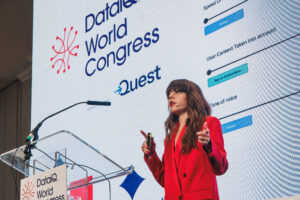
At DataIQ’s World Congress, Ming Tang, Chief Data and Analytics Officer and Chief Digital and Information Officer (Interim), NHS England, described how the health system is shifting from siloed, service-centred care to an event-driven model that better reflects how patients move through the system. Today, referrals, tests and follow-ups are often captured in different systems, creating delays and making it harder for clinicians to act quickly.
Ming outlined a long-term programme to connect those interactions, modernise the flow of information and create the foundation for generative AI to support care safely.
The architectural shift
Digitising processes alone does not deliver better care. As Ming put it, if data is scattered across services, clinicians still lack the context they need for the next best action.
This is why the NHS is moving to an events-based architecture; a model where every interaction becomes a structured event that can be connected, analysed and surfaced when needed. It is a shift that enables real-time insight, demand forecasting and clearer clinical decision support.
Leadership in synchrony
To deliver this, the digital and data functions have been brought together.
“To deliver, we need both of those working in synchrony.”
This alignment allows for shared standards, consistent processes and a more joined-up approach to operational redesign, providing the conditions where AI can be deployed to deliver the transformative care model.
Four programmes enabling connected care
Ming highlighted four major programmes that turn this architectural shift into practical capability across the NHS:
-
The NHS App
Already widely used, it is evolving into a digital front door where patients can access test results, manage prescriptions and, over time, receive AI-supported guidance through their care pathways.
-
The Single Patient Record
A longitudinal, person-centred record built on the new architecture. It supports shared care plans, controlled write-back and secure sharing with carers. Given the sensitivity of the data, it is progressing through careful proofs of concept.
-
The Federated Data Platform
A common data model connecting 240 trusts. Developed through use cases rather than mandates, it helps reduce lost tests, repeated procedures and administrative handoffs.
-
The National Research Service
Developed with the Wellcome Trust, it opens a governed route to using NHS research datasets for clinical trials and population-level studies.
Together, these programmes create the environment in which generative AI can deliver meaningful support to clinicians and patients.
Where AI is already making a difference
Assistive summarisation
Ming’s team began experimenting with AI two years ago. Their current model, built on Anthropic’s Claude and trained on NHS data, produces discharge summaries patients find clearer and easier to understand. Because these outputs influence clinical decisions, they are undergoing MHRA approval.
Ambient voice
Voice-based documentation is a natural fit for clinicians. The next step is automatic coding into clinical systems, followed by triggering routine actions such as booking tests, shifting AI from transcription to workflow support.
Ask FDP
Static dashboards can fail to meet executive needs. Ask FDP, a natural-language interface connected to the Federated Data Platform, allows leaders to explore performance data conversationally. It also shows where information comes from, increasing confidence and reducing the burden on analytical teams.
Join DataIQ to access the full article and all of Ming Tang’s insights.