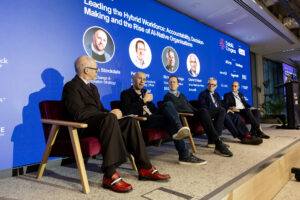
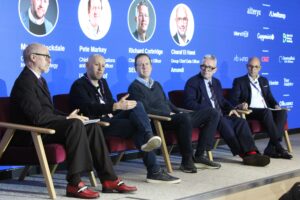
At DataIQ Congress 2026, Richard Corbridge, CIO at SEGRO, Pete Markey, Chief Communications and Marketing Officer at the University of Nottingham, Charaf El Hami, Group Chief Data Officer at Amundi, and Martin Stockdale, former CDO and Partner/COO Change and Innovation Strategy explored what happens when humans and AI agents begin operating side-by-side. Drawing on experiences across asset management, property, higher education, marketing, and law, the panel examined where autonomy should stop, where human judgement still matters, and how organisations need to adapt.
Their discussion pointed to the bigger challenge of organisations needing to decide who remains accountable for decisions, what human capabilities they intend to protect, and whether AI is being used to make existing work cheaper or to create new forms of value.
Accountability must be explicit before AI autonomy
As AI progresses from supporting decisions to making them, accountability becomes harder to define, which is particularly important in regulated industries, where organisations may need to reconstruct and explain a decision years after it was made.

Charaf described Amundi’s approach as establishing AI governance alongside its existing business governance from the outset. Crucially, responsibility does not transfer to the technology when an agent becomes autonomous: “Every agent that is autonomous taking decisions, the name that’s behind the decisions is not an agent; it’s always a human,” he said.
An agent cannot automatically inherit every permission available to the person whose work it supports as personal data, regulatory constraints, access rights, and existing control functions still apply. Charaf explained that guardrails are necessary, but not sufficient; existing control structures need to extend into AI and not be bypassed by it.
Furthermore, accountability needs to be designed before autonomous agents scale. Data and AI leaders need to be able to identify who owns an AI-assisted decision, what information the agent could access, and how that decision can later be reconstructed and defended.
Checking must go into the workflow
Human oversight becomes tangible when AI produces something that appears convincing but is wrong. Pete gave a recent example where he used AI to alter an image promoting a new male skincare brand. Despite instructing it not to change the product packaging, the AI corrupted wording including “facial moisturiser” and “cleanser”. Two people spotted the problem only after zooming into the image once it had been made public.
This event led to a deliberately pragmatic operating model where Pete retains top-level sign-off and specialist resources check individual assets. Similar controls matter for the University of Nottingham’s international marketing, where AI enables creative versioning at scale but cultural context, language, messaging, and brand integrity still require oversight.
It was posed that “human in the loop” is too vague as a governance principle. Leaders need to define exactly what gets checked, by whom, and at which point before an AI output becomes consequential.
Efficiency does not mean value creation
One of the panel’s sharpest challenges was to the assumption that AI’s primary purpose should be to accelerate existing work. The panel used the legal sector as an early warning.
AI products for law businesses are available to professional services firms and their clients. The panel argued that if customers can increasingly solve tasks themselves, simply producing today’s services faster will not necessarily protect incumbent providers.
Martin put the challenge starkly: “That customer using AI is going to displace the need for your solution to exist at all, meaning we’re going to have to find new forms of value in our organisations to stay relevant.”
Reaching beyond professional services, the implication is that AI strategy needs to ask not only what activity can be automated, but what customers will still need the organisation to do once they have access to the same technology.
Decide what human capabilities are worth protecting
Using his experience in property, Richard described it moving through three eras:
- Muscle: when advantage came from constructing and managing physical assets.
- Brain: where data improved optimisation.
- Heart: where empathy and understanding customers become differentiators as technology becomes ubiquitous.
Pete highlighted similarities in marketing. He was comfortable surrendering activities such as versioning and editing to AI, but not the underlying creative proposition. “The core idea of what is a brand – the essence of a brand – I would hate to surrender that to AI,” he said.
For leaders, instead of trying to predict every role AI might remove, they should identify the enduring human capabilities that create differentiation, then structure technology and roles around strengthening them.
Build adaptability through practice, not static AI training
The panel was sceptical that conventional training cycles could keep pace with AI. At SEGRO, Copilot was deployed after principles and guardrails had been established, but employees were encouraged to learn through experimentation. Richard said most of the organisation was finding useful applications within two weeks, while stressing that experimentation could not become a “Wild West”.
Charaf added that AI literacy must include interpreting outputs, understanding errors and hallucinations, and assessing evidence. Confidence scores and traceability help employees judge AI-generated information rather than assuming users accept it blindly.
For education, the problem is pronounced. A university syllabus designed today is preparing students for a technology landscape several years away. Instead, the panel advocated real-world experience, industry partnerships, and an emphasis on enduring principles and frameworks of thought.
AI capability cannot be treated as a one-off training programme. Organisations need governed environments in which employees can experiment, learn, challenge outputs, and continuously adapt.
The next challenge for data and AI leaders is whether their organisations can redesign accountability, skills, and value creation quickly enough to benefit from greater autonomy without losing control of what matters.