The 13th annual DataIQ Congress welcomed some 250 senior data and AI leaders to the City of London to explore what it means to be at The End of AI Theatrics and in an era of accountability, execution, and value.
Hosted by DataIQ’s David Reed, Chief Knowledge Officer and Evangelist, the day moved across keynotes, new reports, executive panels, real-world examples, and roundtables, looking on what happens when AI moves out of the pilot, enters everyday operations, and must withstand scrutiny from boards, customers, employees, and regulators?
The result was that there has been a clear shift in the conversation as AI moves from a technology question to a leadership question.
The human question remains
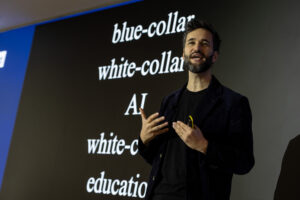
Best-selling author Daniel Susskind, Research Professor in Economics at King’s College London, and Senior Research Associate at the Institute for Ethics in AI at Oxford University, opened Congress by examining what happens to work as machines become capable of activities previously regarded as distinctly human. From writing code and documents to design and medical diagnosis, evolving AI capabilities challenge assumptions about where human expertise begins and ends. He warned that, what have long been considered uniquely human qualities (judgement, intuition, creativity) from an AI perspective can be seen as bounded tasks, that while tackled in a different way, can produce similar outputs.
For data and AI leaders in a constant conversation with different stakeholders, this moves the discussion beyond whether individual jobs will disappear. Organisations need to think about how roles change, what capabilities people will need, and where human judgement remains essential as machines take on a greater share of cognitive work.
Data leaders are judged by business outcomes
The emphasis on value was laid clear in a fireside discussion with Rightmove’s CEO Johan Svanstrom, and CDO and DataIQ 100 alumni, Steve Pimblett. The duo discussed backing their own brand and pursuing their own AI strategy.
Rightmove’s session connected data and AI investment directly with executive leadership. Turning a significant data asset into value requires choices about investment, teams, products, long-term capability, and the outcomes the organisation is ultimately trying to create for customers and the business.
The relationship between CEO and CDO has become particularly important as the role of the CDO has evolved in recent years. Data leaders can no longer make the case for investment purely on technical advancement. They need to connect data and AI capabilities with strategic priorities, demonstrate why investment is required, and create a credible route from capability to measurable impact.
Operating models are part of the AI strategy

The DataIQ 100 Class of 2026 widened the conversation while promoting the real-world benefits of a network such as DataIQ. David Hayes of The Open University, Lauren Sager-Weinstein of Transport for London, Hywel Benbow of GEMS Education, and Indhira Mani of Intact Insurance UK reflected on a year shaped by technology changing at unprecedented rates, rising expectations, economic pressure, and demands for demonstrable value.
Looking ahead to 2027, the CDO agenda goes beyond adopting more AI as leadership, operating models, organisational transformation, and converting technology into outcomes are now inseparable from it.
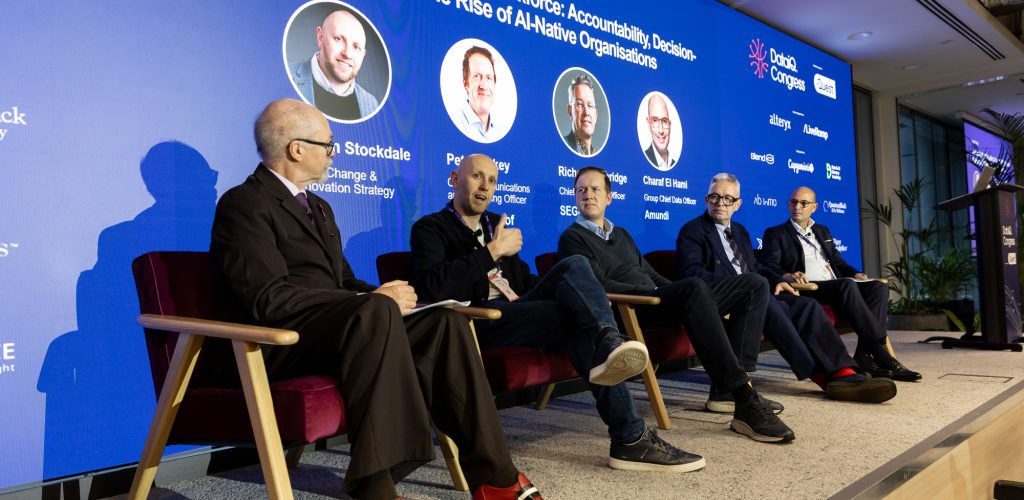
This point became even more explicit during the C-suite discussion on the hybrid workforce with fascinating insights from Martin Stockdale, Partner/COO Change & Innovation Strategy and former CDO; Richard Corbridge, Chief Information Officer at SEGRO; Pete Markey, Chief Communications and Marketing Officer at University of Nottingham; and Charaf El Hami, Group Chief Data Officer at Amundi.
As people work alongside AI systems and agents, organisations face difficult questions about decision rights and responsibility – a set of themes that looks set to dominate 2027:
- What happens when an AI-assisted decision goes wrong?
- Where does accountability sit?
- Which decisions can be delegated versus where must human judgement remain?
The challenge for data and AI leaders is that the organisations to answer those questions successfully will have better AI and operating models designed for a different kind of workforce.
Conversation is where the magic lays

The time dedicated to roundtables for intimate discussions between peers shifted the emphasis from speakers to participants and gave senior practitioners the opportunity to compare approaches, test assumptions, and discuss what is happening inside their own organisations.
This form of peer exchange is central to DataIQ and its events throughout the year. The value of bringing senior leaders together creates the space to challenge lessons against different organisations, industries, operating models, and levels of maturity. Peers learn from success stories and difficulties of similar or radically different organisations to further promote the value and important of the data function within their own business.
What leaders must prove in 2027
Richard Bates, Director, AI and Analytics Platform at Lloyds Banking Group, brought the central challenge of the Congress into focus in the closing keynote: the era of AI theatre is ending. Boards are looking beyond ambition and experimentation to evidence.
- Can the organisation demonstrate measurable value?
- Are responsibilities clear?
- Can its AI systems be trusted under pressure?
- Is governance supporting execution or sitting alongside it?
- Is the organisation ready for AI at scale?
The profession has spent years discussing what AI could make possible. The next phase will be defined by what leaders can make operational, repeatable, accountable, and valuable. Execution is the differentiator after a period of ambition.
For DataIQ, bringing senior data and AI leaders together is at the core of what we do. Congress creates a place where practitioners can move beyond the headlines, compare the realities of implementation, and learn directly from peers tackling the same fundamental challenge of turning data and AI capability into organisational impact.
Register for the DataIQ 100 Summit North America.