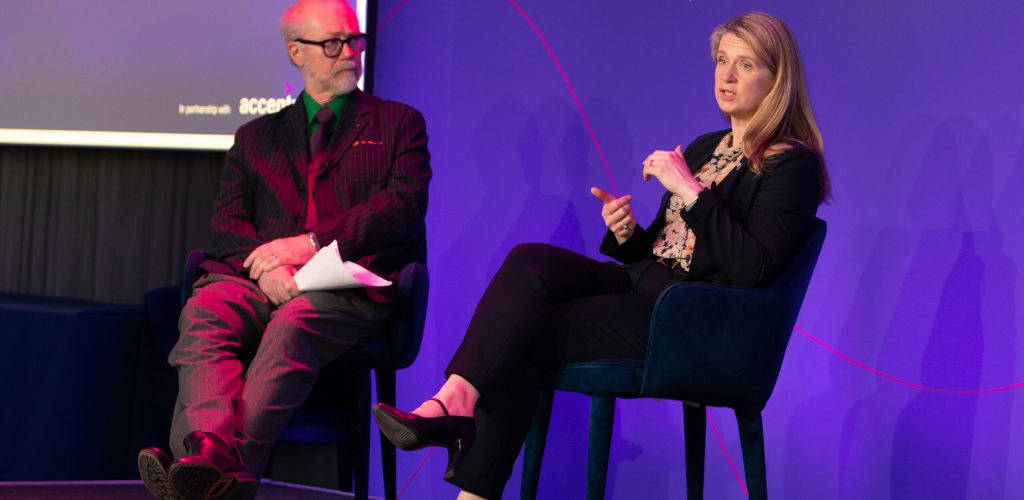
For years, the CDO role has been framed as part evangelist, part technologist, part governance lead, and the assumption was always that, eventually, it would settle. According to Johanna, that moment has arrived, but not in the way many expected. The role has stabilised and expanded.
What is emerging instead is something closer to a systems leader and a role defined less by ownership of data, and more by the ability to orchestrate complexity across an organisation that no longer behaves in neat, centralised ways.
From ownership to orchestration
Johanna describes a profession that is increasingly self-aware. Data leaders are no longer looking upwards for definition; they are shaping the discipline collectively, sharing challenges and solutions in real time.
That shift matters because the environment has changed and AI is now accelerating adoption cycles with organisations running multiple transformations simultaneously. And, crucially, data is no longer confined to a single domain.
“The span of the role has changed quite considerably,” she notes. “You’re now factoring in large-scale transformations, product, operations, people, and financial outcomes all at once.”
The CDO is no longer the centre of gravity as they now sit within a network of competing priorities (engineering, procurement, operations, customer delivery) each with its own pace, incentives, and constraints.
At BAE Systems, Johanna explains, that complexity is amplified. Data flows across sovereign boundaries, defence contracts, manufacturing supply chains, and advanced engineering programmes. Some environments demand caution and compliance; others move at the speed of experimentation, which means that, ultimately, control is neither realistic nor desirable and alignment is the focus.
The myth of the single transformation
One of the more revealing tensions Johanna highlights is between transformation and delivery. Many organisations still treat transformation as a distinct programme that can be planned, executed, and completed. But in environments like BAE Systems, that framing breaks down.
“There’s always tension between delivery and transformation,” she explains. “You can’t change the manufacturing shop floor at the same time that you’re building.”
This is where the systems view becomes critical. Different parts of the organisation move at different speeds where some can absorb change quickly while others are constrained by operational realities. The CDO’s role is not to force uniformity, but to identify where momentum exists and invest there.
Johanna’s “slot machine” analogy captures this mindset neatly. She explains that each day comes with a finite amount of energy (tokens for the slot machine) and leaders choose where to place their bets (tokens), knowing that many will yield nothing. The task is to recognise when something starts to move and double down. This pragmatic approach is a deliberate rejection of the idea that transformation can be centrally engineered and instead are cultivated.
Letting things fail on purpose
Actively allowing initiatives to stall in undoubtedly an uncomfortable leadership behaviour.
“There’s a great technique of letting something fail before you go into it,” Johanna says.
In a profession that prides itself on solving problems, this can feel counterintuitive, but the logic is straightforward. Not every idea will land, regardless of its technical merit and organisational readiness (culture, familiarity, trust) ultimately determines whether something takes hold. Pushing against that reality is rarely productive and consumes energy without generating impact.
“If it’s not landing, that’s an awful lot of energy that might deliver no value,” she notes.
For CDOs, this requires a shift from the traditional mindset. Success is not defined by the number of initiatives launched, but by the ability to recognise where the organisation is receptive, and where it isn’t.
AI is an operating model question
In defence and engineering contexts, AI is not new as BAE Systems has been deploying advanced analytics and AI capabilities for decades. The recent surge in GenAI has changed the conversation, but not the underlying challenge: operationalisation.
Johanna draws a clear distinction between innovation and scale, explaining that many organisations have no shortage of brilliant individuals (PhDs, engineers, specialists) developing sophisticated models in isolation. But the harder question is how those models become repeatable, scalable capabilities embedded into the business.
“What we are driving towards is operationalisation at pace and scale,” she explains.
This requires a different kind of coordination as you must build something that works, can be handed over, integrated, and run reliably by others. The friction lies in the grey area between domains where engineering expertise meets digital, data, and cyber capabilities where, unfortunately, ownership is inherently ambiguous.
Rather than resolving that ambiguity, Johanna suggests it needs to be managed. Over time, as AI becomes more commonplace, some of the current tension will dissipate and what feels contentious today will become routine.
Trust as infrastructure
Data sovereignty, classification, and international partnerships in a defence organisation such as BAE introduce constraints that most commercial organisations do not face, such as decisions about data sharing being inseparable from geopolitical considerations.
“You’re always working with government, and you’re always lagging behind policy,” Johanna notes.
This creates an additional layer of complexity for data and AI leaders as they are enabling internal transformation in addition to navigating external expectations that are constantly evolving.
At the same time, trust operates internally. Johanna describes the CDO increasingly being seen as a “trusted advisor” across a wide range of activities, from procurement decisions involving AI companies to customer-facing engagements with governments. That shift reflects a broader change in how the role is perceived as no longer a technical specialist brought in to solve a specific problem, but a generalist with depth to operate across domains.
Rethinking value
The definition of value has expanded alongside the role definition. Financial returns remain important, but Johanna is explicit that they are no longer sufficient on their own. For example, workforce dynamics are becoming increasingly material, and an ageing engineering population and constrained talent pipelines mean that retention and working environment are now strategic concerns.
“How do you create an environment people want to work in?” Johanna asks.
Data initiatives have moved beyond cost savings or revenue generation metrics and are now assessed on their contribution to organisational resilience, such as improved working conditions, ESG outcomes, or the ability to deliver against long-term contract backlogs.
CFOs, Johanna admits, are not yet fully incorporating these metrics into financial models, but they are part of the discussion.
Influence over expertise
Johanna’s approach revolves around the emphasis on influence. Technical depth still matters, but it is no longer the limiting factor for senior leaders. The challenge, now, is navigating an organisation with multiple power centres, each with its own priorities.
“It’s not always the CFO who has the influence,” she points out.
This requires understanding organisational culture, adapting communication styles, and knowing when to step back. In some cases, that means deliberately removing oneself from the centre of a decision. Johanna describes bringing in neutral facilitators to manage conflict, rather than inserting her own authority.
It also means knowing when to deploy others. Leadership, in this context, is less about personal visibility and more about enabling the right people to operate in the right places, and this involves repetition.
“We have a terrible habit of doing something amazing and then never talking about it again,” she says. “You have to keep telling the story.”
A profession coming of age
The CDO community is becoming more diverse, more collaborative, and more confident in defining its own direction, and this matters for representation and capability. A broader range of perspectives translates into a broader set of solutions, which is invaluable in complex, high-stakes environments.
The UK’s position as a leader in data and AI remains a point of focus. Johanna is clear that maintaining that position will depend on the collective strength of the ecosystem and implies that the next phase of the profession will be shaped by shared practice and not job titles.
The real shift
It would be easy to interpret the stabilisation of the CDO role as a sign that the uncertainty is over, but Johanna’s view and experience suggest the opposite. The ambiguity hasn’t disappeared but has been absorbed into the role itself.
Today’s data and AI leader is expected to operate across domains, manage competing cadences, balance innovation with delivery, and redefine value while building trust internally and externally. It is not a role that can be neatly defined or contained, but it is one that looks less like a specialist function and more like a form of organisational leadership.