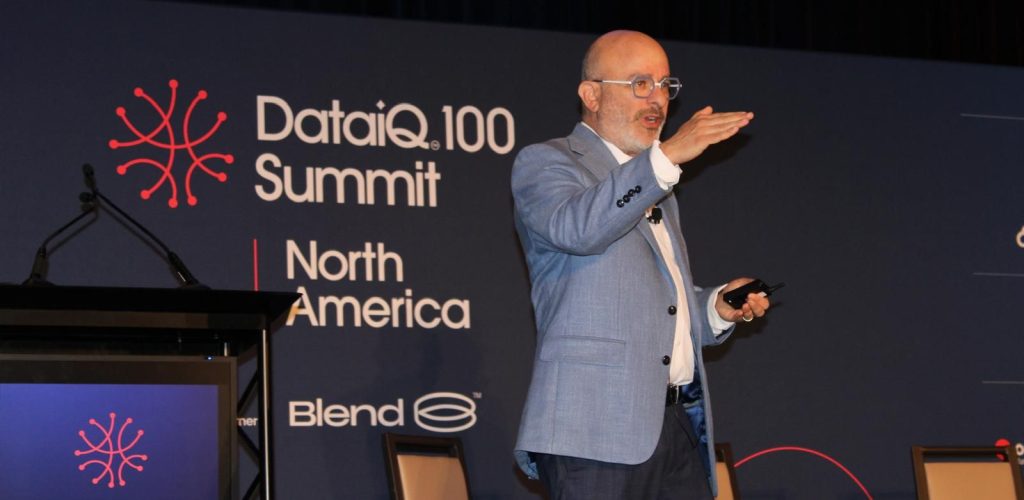
Keynote: Creating the Conditions for Innovation – A CTO Perspective for CDOs
Speaker: Yuri Aguiar (Tokio Marine North America Services)
This session reframed innovation as a structural challenge from the traditional technical challenge. While much of the industry remains focused on tooling and models, Yuri pointed to culture, talent, and execution frameworks as the real determinants of whether AI ambition translates into enterprise impact.
What was most prominent was the positioning of data leaders as the drivers of innovation, responsible for creating the conditions in which innovation can scale consistently across the business.
Key insights:
- Enterprise execution remains the gap. Many organizations are still strong in experimentation but weak in scaling outcomes.
- Culture is a multiplier. Without alignment on ways of working, even well-funded AI initiatives stall.
- Frameworks matter. Repeatable structures are what turn isolated success into operational capability.
- The CDO role is expanding. Data leaders are increasingly accountable for transformation, not just delivery.
Keynote: From Data Chaos to AI-Ready – Building Trusted Data Products at Scale
Speaker: Susan Laine (Quest Software)
This keynote cut through the narrative that model sophistication is the primary constraint on AI progress and redirected attention to the underlying issue of fragmented, low-trust data.
Susan made a compelling case for data products as the mechanism for resolving this, shifting organizations away from project-based delivery toward reusable, governed assets designed for scale from the outset.
AI readiness is less about adding capability and more about redesigning how data is produced, managed, and consumed across the enterprise.
Key insights:
- Data, not models, is the bottleneck. Fragmentation and low trust continue to limit AI at scale.
- Data products provide a path forward. Reusability and governance need to be built in, not retrofitted.
- AI can accelerate its own foundations. Automation is increasingly being used to improve data quality and readiness.
- Scale requires standardization. Without consistent data design, enterprise-wide AI remains out of reach.
Keynote: The Business of Data Platforms – A Product Lens for CDO Leadership
Speaker: Amin Venjara (ADP)
Amin challenged one of the more entrenched assumptions in enterprise data that platforms are primarily infrastructure investments. Instead, he positioned them as products with users, demand patterns, and measurable outcomes.
This shift forces a reorientation of CDO priorities away from delivery and towards value creation, with accountability for adoption and impact rather than just availability.
Key insights:
- Platforms must be treated as products. Success is defined by usage and outcomes, not deployment.
- Demand-led design is critical. Platforms built without clear use cases struggle to gain traction.
- Value creation is the new mandate. CDOs are increasingly measured on business impact.
- Product thinking helps manage complexity. It provides a scalable way to align stakeholders and priorities.
- Executive alignment is non-negotiable. Platform strategy must connect directly to enterprise goals.
Data Management That Thinks: Why the C-Suite Decides Whether Enterprise AI Succeeds
Speakers: Mark McQueen, Matt McQueen (Ortecha), Patrick Girasole (Ardoq)
As AI capabilities become more commoditized, this session focused on a less visible constraint: the accessibility of business context.
Today, much of an organization’s intent (its rules, decisions, and logic) remains locked in documents, systems, and institutional knowledge. This creates a ceiling for AI, limiting its ability to reason effectively about the business it is meant to support.
The discussion introduced the idea of machine-readable governance and knowledge architecture as the next frontier by making business context explicit, structured, and usable by AI systems.
Key insights:
- Capability has been replaced by context as the differentiator.
- Business knowledge remains fragmented. Most organizations have not made it accessible to machines.
- Machine-readable governance is emerging. Encoding rules and intent enables more reliable AI decisions.
- The C-suite has a critical role. Making business intent executable is a leadership responsibility.
Driving Business Transformation with AI Capability – What’s Working with Agentic
Moderator: Asha Saxena (WLDA)
Speakers: John Rogers (Cotality), Chaitanya Garikapati (Mars Petcare), Karthik Ilangovan (MODE Global)
This panel grounded the conversation in operational reality, focusing on how organizations are translating AI investment into measurable outcomes.
Rather than presenting polished success stories, the discussion highlighted the friction points such as fragmented data, governance complexity, and the challenge of aligning AI initiatives with business priorities.
What emerged was a pragmatic view of agentic AI as a gradual shift toward more embedded, decision-oriented systems.
Key insights:
- Impact remains uneven. Many organizations are still early in converting investment into outcomes.
- Fragmentation persists. Data and organizational silos continue to slow progress.
- Governance is a balancing act. Speed and control must be managed simultaneously.
- Value is emerging in targeted areas. Focused use cases are still the primary driver of return.
How Can We Successfully Innovate Within Highly Regulated Environments?
Moderator: Justin H.
Speakers: Moataz M. (First Citizens Bank), Tifani McCann (Otsuka), Sudarsan Kumar (Truist)
For organizations in regulated industries, the question is how to adopt AI without compromising compliance and trust.
This session explored the inherent tension between innovation and control, with speakers emphasizing that governance cannot be treated as a constraint layered on top of innovation but must be designed into it from the outset.
Key insights:
- Regulation does not preclude innovation. But it does change how it must be executed.
- Governance must be embedded. Retrofitting controls slows delivery and increases risk.
- Trust is non-negotiable. Especially in regulated sectors, it underpins adoption.
- Speed requires clarity. Well-defined frameworks enable faster, safer decision-making.
Keynote: The Data Leader as Transformation Architect
Speaker: Bharathi Rajan (Swire Coca-Cola, USA)
This session brought together many of the themes of the day, positioning the modern data leader as the architect of enterprise transformation as opposed to a steward of data assets.
Bharathi highlighted the importance of unifying data, AI, and digital under a single strategic vision by reducing fragmentation and enabling more consistent execution at scale.
The emphasis was on ownership: without clear accountability across platforms, data, and outcomes, organizations struggle to move beyond isolated success.
Key insights:
- Leadership roles are converging with data, AI, and digital increasingly being managed as a unified capability.
- Foundations still matter as scaling AI depends on robust, aligned platforms.
- Ownership drives execution. Clear accountability enables faster and more consistent outcomes.
- Operating models need to evolve. Traditional structures are not designed for AI-driven enterprises.
Keynote: Vibe Coding for Business – From Months to Minutes with Your Own Data
Speaker: Ari Kaplan (Databricks)
The closing keynote provided a contrast to the structural focus of the day, demonstrating how rapidly development cycles are compressing through new approaches such as so-called “vibe coding.”
While the demonstration highlighted the speed at which data-driven applications can now be built, the broader message was more measured stating that acceleration without governance introduces new risks.
The real challenge for data and AI leaders is ensuring that speed does not come at the expense of control, security, and trust.
Key insights:
- Development is accelerating rapidly and hat once took months can now take hours.
- Proprietary data is a differentiator. Competitive advantage comes from what organizations uniquely own.
- Speed introduces new risks, and governance and oversight must keep pace.
- Human oversight remains critical. Automation does not remove accountability.
The final day of the Summit made clear that the barriers to scaling AI are no longer primarily technical and have become organizational.
Whether through product-led platforms, machine-readable governance, or new leadership models, the focus has shifted toward building enterprises that can operate with intelligence and move beyond solely experimenting.
The implication is significant. As highlighted across both days, success in data and AI is increasingly defined by what organizations can embed, govern, and execute consistently at scale, rather than just by what can be built.