
This article is written in partnership with Rishi Kapoor, Head of WW Partner Sales Engineering, Alteryx & DataIQ 100 2026 Enabler.
AI experimentation has become easier, but AI production remains an operating commitment.
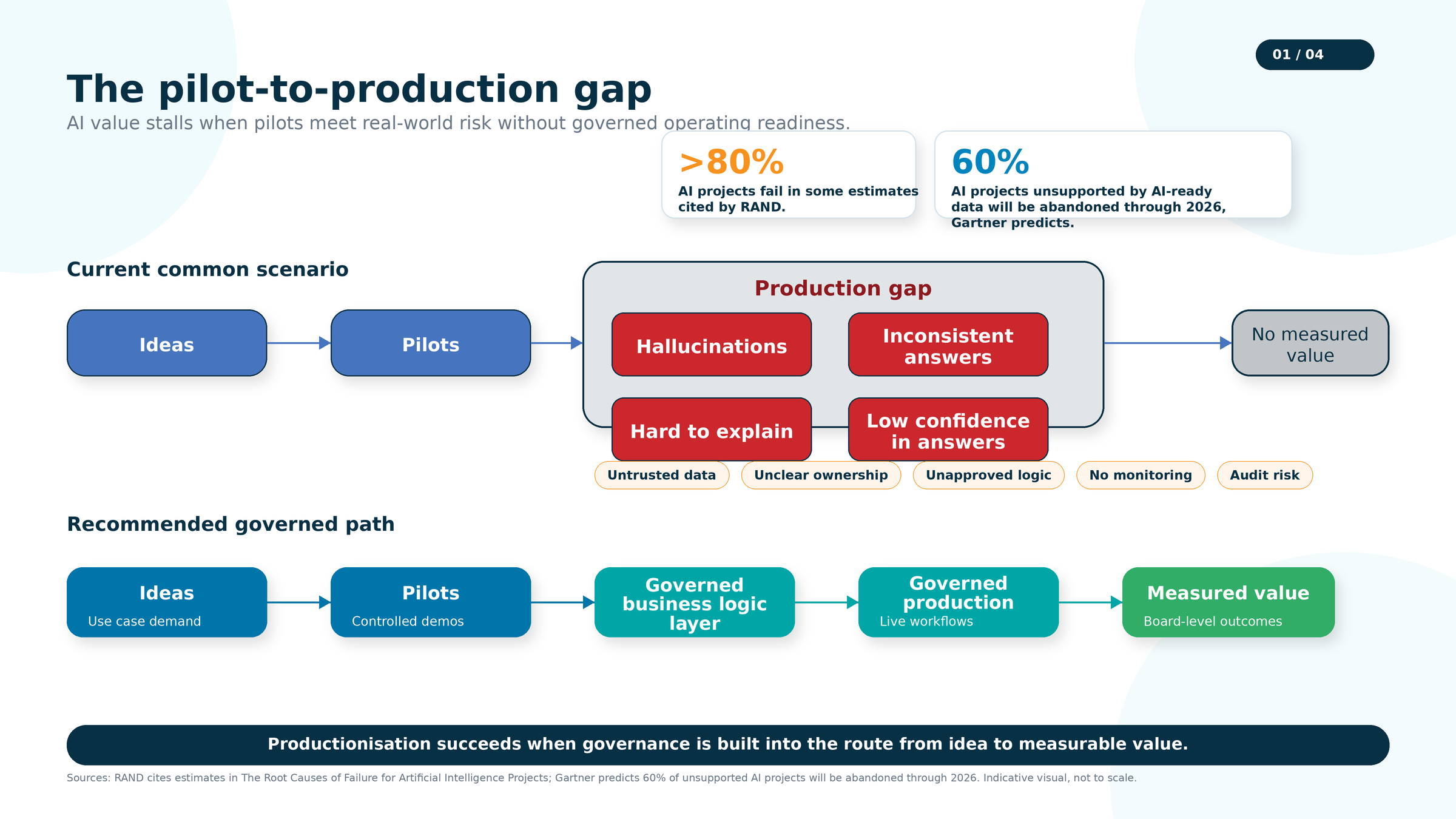
By some estimates cited by RAND, more than 80% of AI projects fail. The precise number will vary by organisation, industry, and definition of success, but the executive lesson is consistent: the challenge has moved from proving that AI can work to proving that it can work reliably, repeatedly, and responsibly inside a complex enterprise.
A pilot lives in a controlled environment. A production AI capability touches live data, frontline workflows, customers, financial controls, risk models, compliance obligations, and people’s roles. It must survive data drift, exceptions, audit questions, access changes, ownership changes, and the daily reality of legacy systems. That is where many AI initiatives stall.
“Governance is not the opposite of speed. It is the operating system that allows speed to scale.” – Rishi Kapoor, Head of WW Partner Sales Engineering & Solutions: Technology & Innovation Partners, Alteryx
This is why governance needs a rebrand. Too often, governance is positioned as a brake: a checklist applied after innovation has happened. In the AI era, that framing is no longer useful. Governance is the mechanism that allows organisations to move from isolated experimentation to enterprise performance in production.
From model governance to decision governance
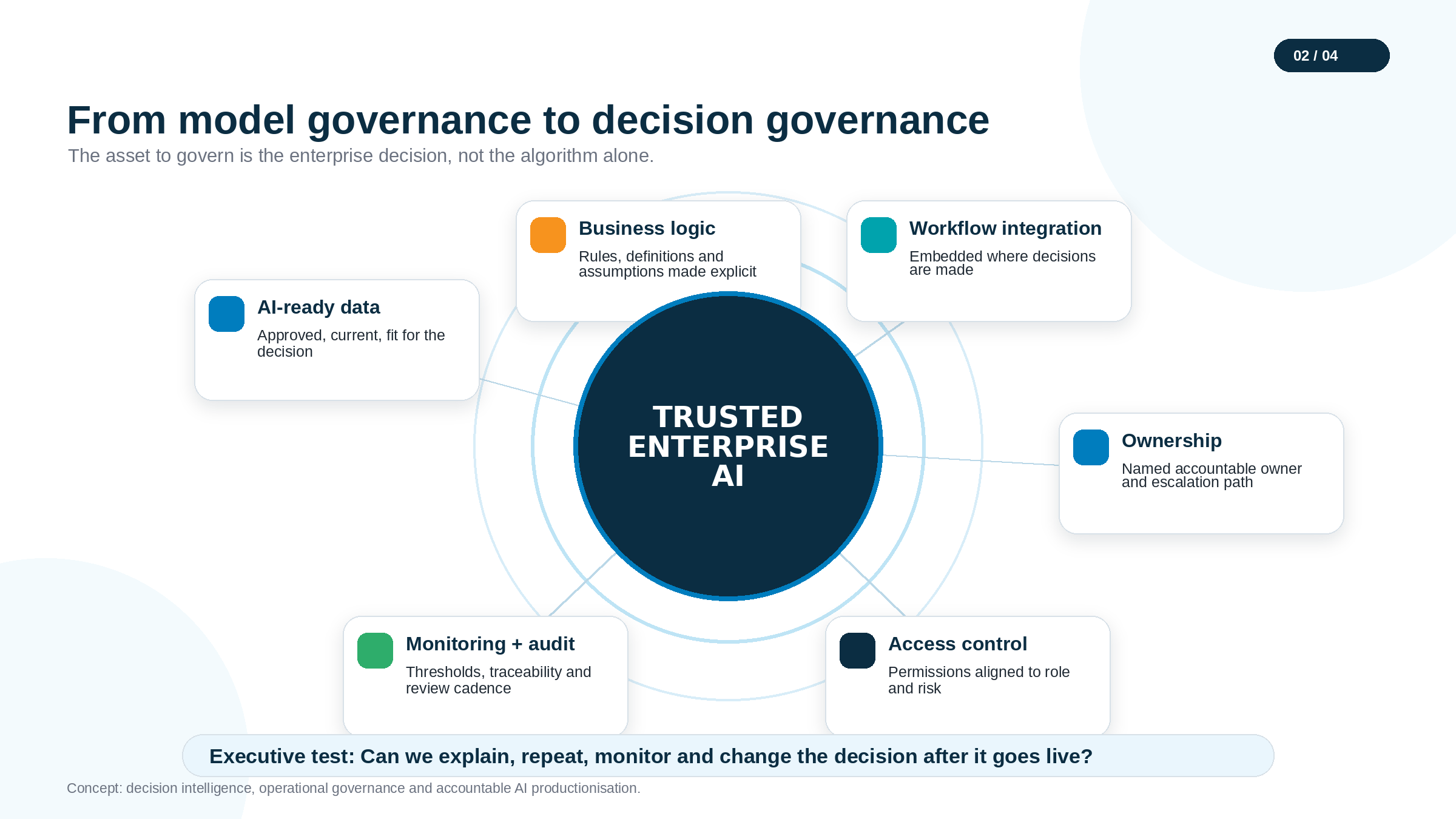
The first shift is to govern the decision in addition to the model. Most organisations now have some form of responsible AI policy, model review process or risk committee which is important, but they are not sufficient. AI creates value only when it improves a decision or action in the business, whether in finance, supply chain, customer operations, risk, sales, marketing, or HR.
A governed AI decision should have a business owner, a measurable outcome, approved data inputs, documented business logic, clear escalation routes, monitoring thresholds, and a process for revision or retirement. This is less glamorous than a prototype, but it is what creates confidence at scale.
It also aligns with the emerging language of decision intelligence. The competitive question is moving from “can we generate insights?” to “can we consistently make better decisions?” That distinction changes the governance lens. Organisations need to know not only whether an algorithm is technically acceptable, but whether the end-to-end decision flow is accountable.
Business logic is the new critical asset
The second shift is to recognise business logic as a critical enterprise asset, especially as AI models are increasingly accessible. What remains genuinely differentiating is the embedded knowledge of how the business actually works: pricing rules, tax treatments, risk tolerances, reconciliation logic, customer definitions, approval thresholds, regulatory interpretations, and exceptions built up over years.
Too often, that logic sits in spreadsheets, local scripts, undocumented workflows, emails, or individual expertise. In a pilot, a small team can compensate for this manually; in production, it becomes a control failure.
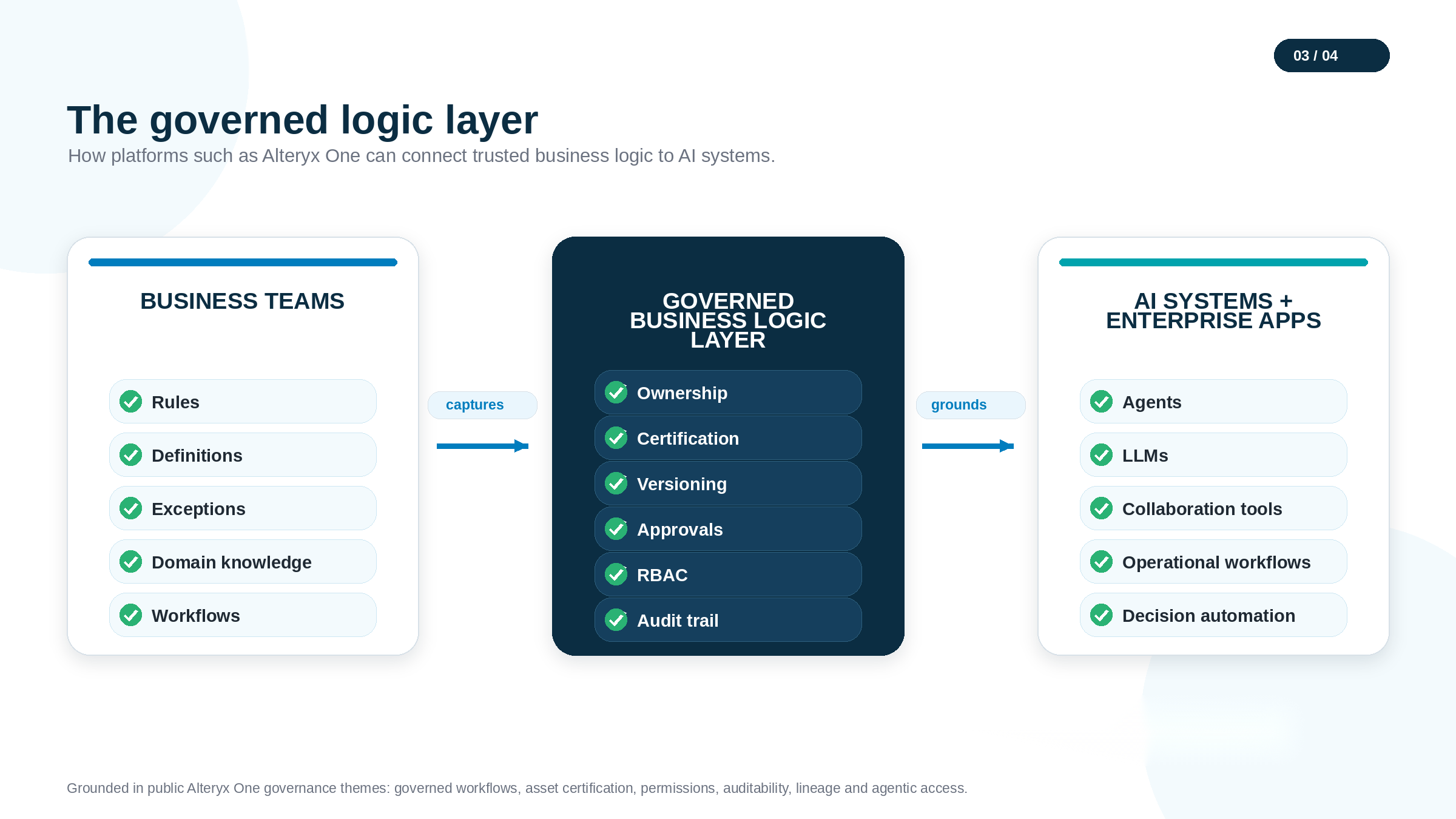
External platforms designed by specialists help bridge the gap between business speed and enterprise control. The strategic value is in automating analytics and preparing data in addition to helping organisations make business logic visible, reusable, and governable. Workflows can capture how data is transformed, which rules have been applied, who owns the process, and whether the asset is trusted for wider use. When that logic is versioned, certified, and auditable, it becomes a foundation for AI rather than an informal workaround outside the control environment.
Productionisation is a governance discipline
Agentic AI raises the bar further. When AI systems begin to trigger workflows, take actions, or support operational decisions, a prompt is not a control framework. Agents need to be grounded in trusted data, approved workflows, and business rules the organisation understands. They need to operate within permissions, inherit the right context, and leave behind a traceable record of what happened.
Recent AI platform capabilities point in this direction, from data labels, asset certification, workflow versioning, role-based permissions, and auditability to emerging agentic capabilities designed to connect trusted datasets and governed workflows into AI-enabled experiences. The message for executives is the need for an operating layer in which business logic is visible, permissions are clear, and outcomes can be explained after the fact.
Business teams need freedom to build and improve the workflows that reflect real decisions, while IT, data, and risk leaders need visibility and control to ensure those workflows are secure, compliant, and scalable. The answer is federated innovation within governed guardrails.
The C-suite question: What are we willing to trust?
For the C-suite, the AI conversation has moved beyond use cases, asking “what are we willing to trust AI to do?”
That question should be risk-based. A productivity assistant drafting internal content does not require the same level of oversight as an AI-enabled decision affecting financial reporting, regulated advice, customer eligibility, or supply chain resilience. But every AI initiative needs a classification, an accountable owner, and a path to measurement, as, without it, organisations create activity without assurance.
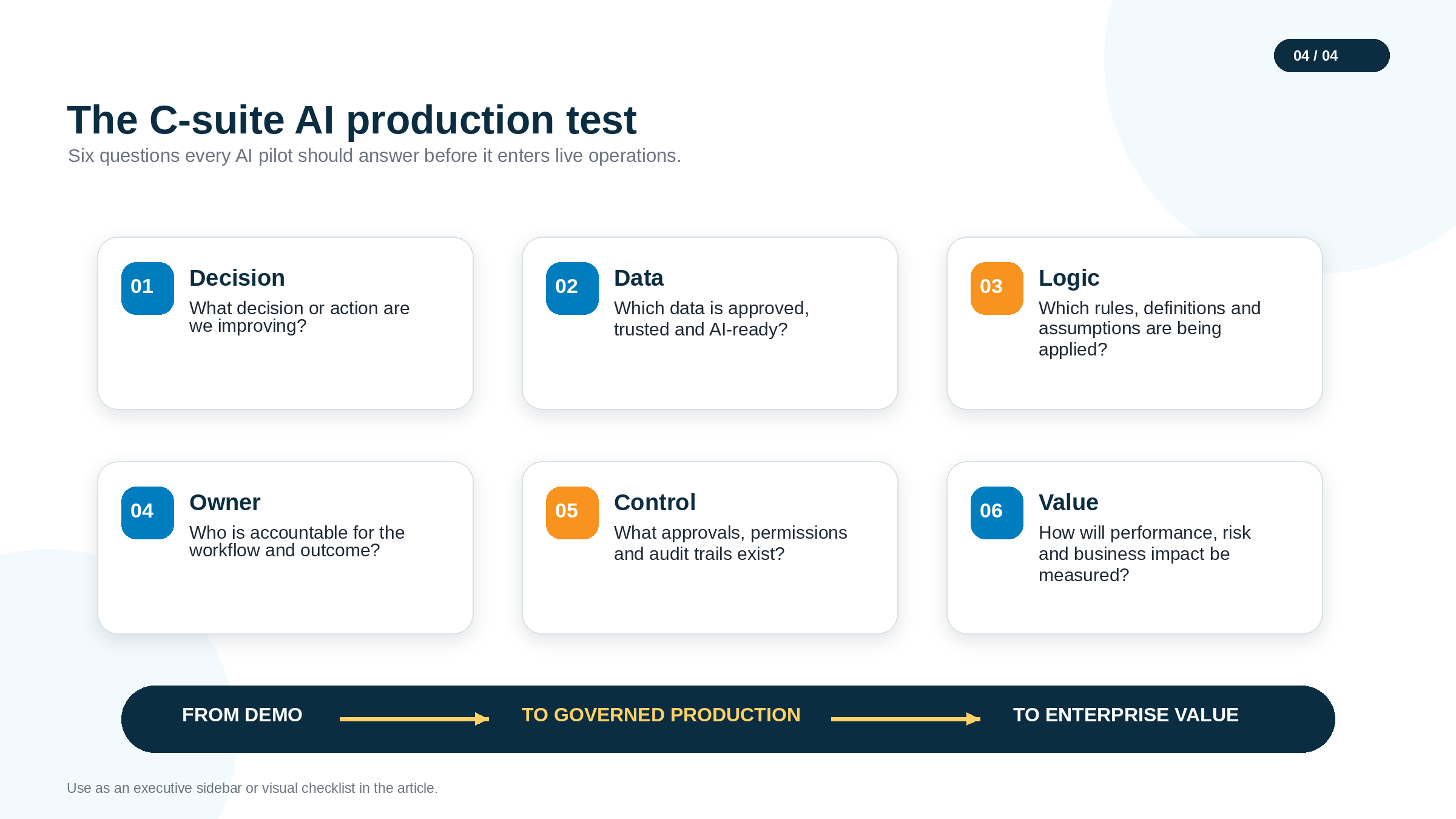
Before moving a pilot into production, executives should ask six questions:
- What decision are we improving?
- Which data is trusted for that decision?
- What business logic is being applied?
- Who owns the workflow?
- How will we monitor performance and exceptions?
- What evidence will tell us whether the initiative created value?
“The winners in AI will not be the organisations with the most pilots. They will be the organisations with the highest conversion rate from trusted experimentation to governed production.” – Rishi Kapoor, Head of WW Partner Sales Engineering & Solutions: Technology & Innovation Partners, Alteryx
This is the inflection point for data and AI leadership in 2026. The past phase was defined by access to powerful AI and the next phase will be defined by the ability to operationalise it. Boards will care less about how many pilots exist and more about how many decisions have improved, how much risk has been reduced, how much manual work has been removed, and how reliably the organisation can explain what happened.
This is the conversation worth having. AI will not be productionised through ambition alone. It will be productionised through trusted data foundations, governed business logic, accountable workflows, and a shared operating model between the business and IT.
Governance is the condition for AI progress.
Contact Alteryx to see how their expertise can improve your AI capabilities.