
So what?
For years, data literacy programmes have been the cornerstone of empowering organisations to make better decisions with data. While launching these programmes has been a challenge, the greatest complexity has been proving that they work.
As data and AI capabilities become more deeply embedded across organisations, the question of impact is becoming harder to avoid. Participation rates, course completions, and satisfaction scores may demonstrate engagement, but they rarely answer the question executives care most about: what difference has this made to the business?
This challenge was the focus of a recent DataIQ closed peer discussion, where data and AI leaders from sectors including financial services, healthcare, defence, retail, and agriculture compared how they are approaching measurement and ROI. They shared a range of methods that took into consideration their different levels of maturity, organisational context, and business priorities.
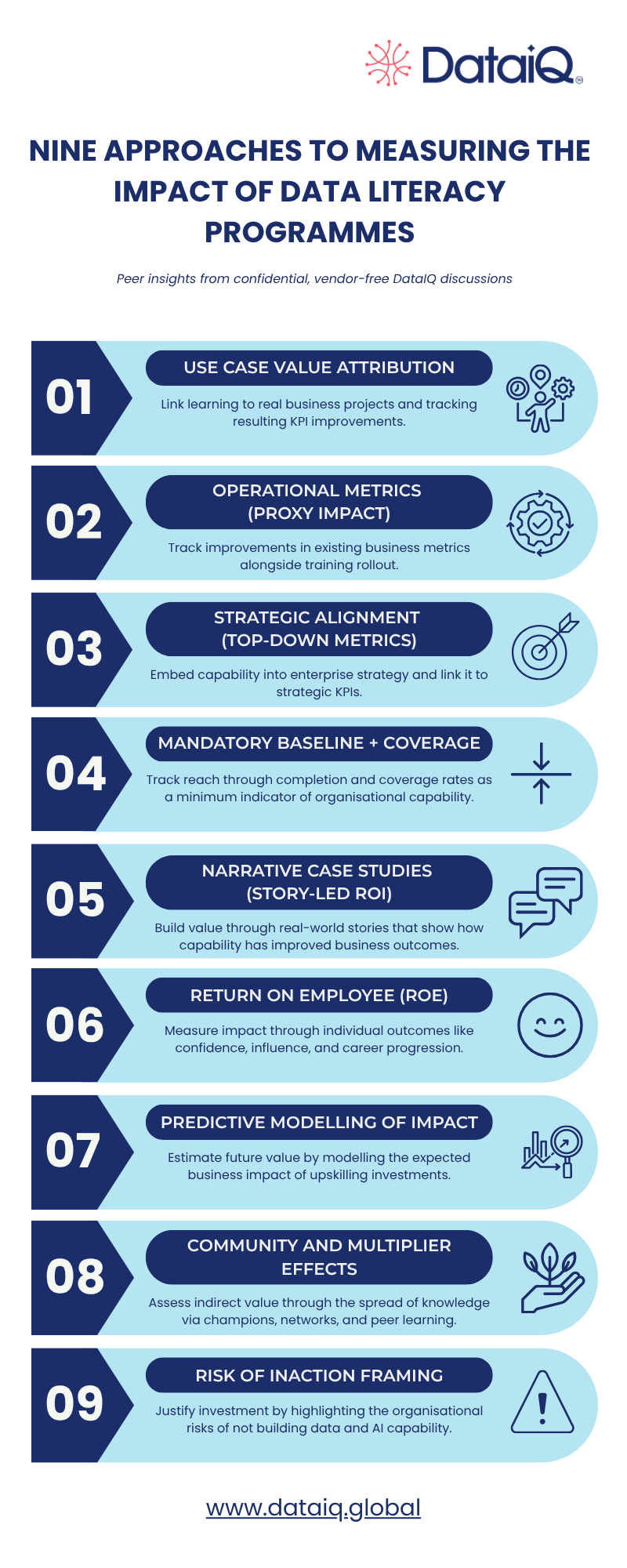
The infographic below captures nine key approaches that arose.
A blended approach to proving impact
As the infographic reflects, organisations are not pursuing a single measure of success to communicate the ROI of their data literacy programmes. Instead, leaders are taking a blended approach to evidencing impact, combining business outcomes, workforce indicators, and narrative proof points to build a more credible picture of value.
This includes tying:
- capability-building directly to use cases and operational KPIs
- individual outcomes such as confidence, influence, and career progression
- predictive modelling to estimate the potential impact of upskilling before programmes are delivered.
Beyond “data literacy”
The diversity of approaches highlights a broader shift taking place.
Several leaders in the discussion described moving beyond the traditional concept of data literacy, finding the term itself increasingly limiting as it signals training, not outcomes, and positions the data team as the owner.
In response, they are reframing their efforts around concepts the business already values — decision-making, operational effectiveness, and AI readiness. This is already changing how these programmes are received: those framed in terms of business outcomes gain stronger engagement, clearer executive backing, and, in some cases, formal mandate through enterprise strategy. Peers report that the more capability is positioned as a driver of performance, the easier it becomes to embed and the harder it is to treat as optional.
DataIQ clients can access the full summary via the Client Hub, including a deeper exploration of the discussion, practical approaches being adopted by peers, and the questions organisations are now asking as they move beyond traditional data literacy models.
Data and AI leaders can also apply to join our confidential peer exchanges here: What’s on – DataIQ
Not a DataIQ client yet? Get in touch to learn more about how DataIQ helps data and AI leaders tackle the challenges shaping the profession today.