
The decisions that shape success and where programmes struggle
While each organisation’s context is different, during recent DataIQ closed-door peer discussions, leaders spoke of the same set of decisions that repeatedly surface often early in the programme, and often with long-term consequences.
These decisions are not always treated as such. In many cases, organisations move forward without fully resolving them, only to encounter issues later around performance, governance or adoption.
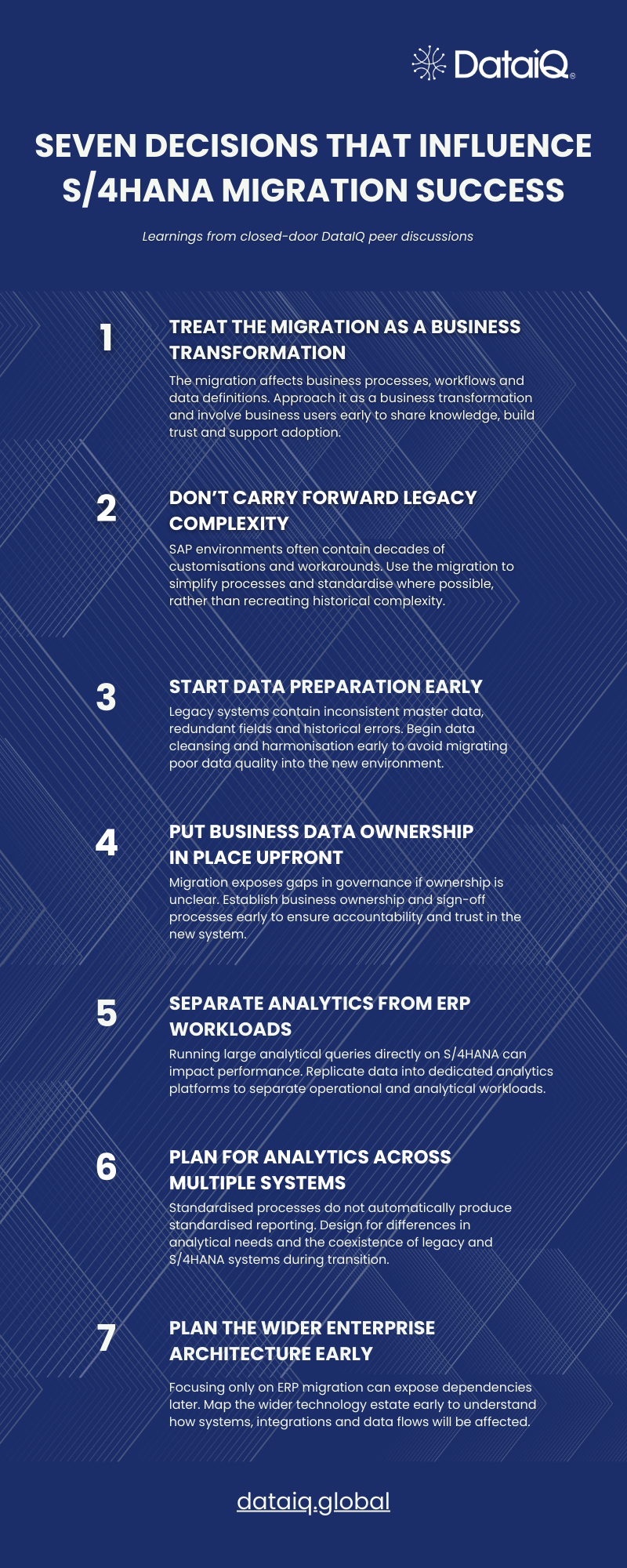
The infographic below distils seven of the most important decisions identified by senior data and AI leaders who are actively navigating S/4HANA migration today. It highlights where programmes tend to stall, and where a more deliberate approach can make a material difference.
Where organisations are focusing their efforts
Treating the migration as a business transformation
One of the most consistent lessons is that S/4HANA migration cannot be approached as a technical upgrade. Changes to data models, financial structures and reporting hierarchies have direct implications for how the business operates.
Organisations that involve business stakeholders early, particularly around data definitions and process changes, are better positioned to avoid late-stage redesign and resistance during adoption.
Starting data preparation earlier than expected
Data preparation is proving to be one of the largest and most underestimated workstreams. Many organisations are dealing with decades of accumulated complexity, including inconsistent master data, redundant fields and conflicting definitions across regions.
Some have begun data cleansing and harmonisation years ahead of the system migration itself, recognising that without this work, the new environment risks inheriting the same issues.
Designing analytics architecture deliberately
Another area of active debate is how S/4HANA should interact with existing analytics platforms. Rather than consolidating everything into SAP, many organisations are choosing to maintain separate analytics environments.
This is often driven by performance considerations, but also by a desire to retain flexibility. Some are introducing intermediate layers that standardise data and allow different tools to be used for different purposes, rather than committing to a single platform too early.
A practical summary of peer experience
The infographic below captures seven decisions that repeatedly emerge in S/4HANA migration programmes. Together, they provide a practical guide to where organisations are focusing their attention and where common challenges tend to arise.
Moving from insight to execution
While these decisions are widely recognised, the way organisations approach them varies significantly depending on their starting point, industry constraints and existing technology landscape.
In the full peer discussion, leaders share how they are:
-
balancing standardisation with local requirements
-
structuring data ownership and governance
-
designing architectures that support both ERP and analytics
-
managing phased rollouts and system coexistence
-
preparing the business for changes to processes and reporting
Access the full discussion
DataIQ clients can access the full summary of this peer discussion here: Transitioning to S/4HANA: Key Decisions and Lessons Learned | DataIQ
Join DataIQ to explore how your peers are approaching these decisions in practice and what they would do differently.