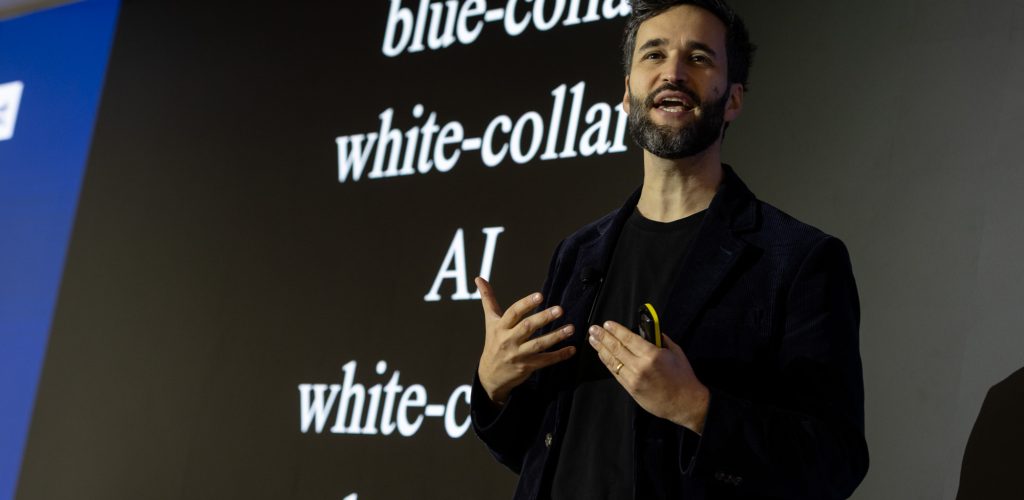
AI’s impact on work will not be confined to routine or manual jobs. At DataIQ Congress 2026, Daniel Susskind, Research Professor in Economics at King’s College London, Senior Research Associate at the Institute for Ethics in AI at Oxford University, and best-selling author, challenged data and AI leaders to rethink how technology will reshape professional work. His message was pragmatic: analyse work at task level, prepare people for redeployment, and make education and retraining a continuing investment rather than a one-off intervention.
White-collar work is no longer protected by complexity
Throughout history, technology has been reshaping work – this has been true across eras, geographies, and niches, and it continues today with AI. The assumption, historically, has been that automation primarily threatens routine, manual work, while professions requiring judgement, creativity, or expertise are relatively protected.
Daniel used agriculture data as a benchmark. In the US, the share of agriculture employment fell from 26.9% in 1860 to 1.2% by 2000, and in the UK, agricultural output is five times its 1860 level, while requiring just 10% of the workers. Daniel then showed how UK manufacturing tells a similar story with production around 2.5 times its late-1940s level, with 40% of the workforce.
What this means is that leaders today must question whether AI is beginning to bring the same productivity dynamic to professional work that was previously seen as protected. GenAI makes that question more pressing because it can perform activities that do not look traditionally routine:
- Writing
- Analysis
- Diagnosis
- Problem-solving
Activities associated with professional expertise are within technology’s reach. That does not mean AI suddenly thinks like a lawyer, doctor, accountant, or data leader, and Daniel’s point was that it does not have to.
Do not assume AI needs to think like people
Daniel calls the belief that machines must reproduce human reasoning to perform a task the “artificial intelligence fallacy”. He explained that the lesson can be seen in Garry Kasparov’s 1997 defeat by IBM’s Deep Blue. The machine did not replicate the intuition of a world chess champion; instead, it used enormous processing power and data storage to approach the problem, calculating up to 330 million moves a second.
As Daniel stated: “There are lots of ways of being smart that aren’t smart like us.” That distinction is imperative for organisations evaluating what AI can and cannot do.
When considering professional judgement, asking whether AI can exercise judgement in the same way as a person is the wrong test. Instead, leaders should ask what problem that specific use of judgement is solving. If its purpose is to make sense of uncertainty, could a system address that uncertainty through access to more information and pattern recognition at greater scale?
Daniel illustrated this with a Stanford system developed in 2017 that could assess whether skin lesions were cancerous with accuracy comparable to leading dermatologists. The important thing to note is that the system did not reproduce a doctor’s reasoning; it analysed a database of around 140,000 previous cases and detected patterns.
For data and AI leaders, this changes how to identify automation opportunities: ask whether AI can achieve the outcome through a different route rather than asking if AI can imitate the team’s best people.
Break jobs down into tasks
Daniel discussed how “jobs should be broken down into tasks” when there are talks about AI replacing lawyers, doctors, analysts, or data scientists. The reality is that every role combines many different activities, and those activities will not be equally affected by technology, so they should be broken down and analysed as to which tasks within those jobs can be addressed by AI solutions.
Daniel pointed to a pre-generative-AI study of 820 US occupations that showed only 5% of jobs could be fully automated using technologies available at the time. However, 60% of jobs contained individual tasks where 30% or more could be automated, which is a distinction that provides leaders with a practical way of thinking about AI.
Rather than starting with, “which roles can we automate?”, leaders should map the activities within those roles. Identify which are routine, which can already be performed differently using AI, which remain dependent on human capabilities, and which new tasks technology creates.
Prepare for mass redeployment
Education and training are what Daniel sees as the most important near-term response to AI disruption. He argued that organisations should prepare for what he described as “a story of mass redeployment” as people move towards activities that have not been automated. For leaders, workforce strategy needs to address three questions:
First, what are people learning? Daniel suggests two broad strategies: develop capabilities that technology cannot yet provide and teach people to use AI effectively and critically. Training that does neither risks preparing employees for activities technology already performs well. He used an example of the traditional early career of a junior lawyer, built around document review, assembly, and retrieval – all tasks that are performed well by technology.
Second, how are people learning? AI creates opportunities to personalise education and build simulated learning environments, changing a model of classroom education that has remained remarkably consistent despite advances in technology.
Third, when are people learning? Education remains heavily concentrated at the beginning of people’s lives, even as technology increases uncertainty about which capabilities will be valuable decades later. Daniel argued that the most effective response to this uncertainty is flexibility around the capacity and willingness to retrain throughout working life.
For employers and team leaders, this makes continuous reskilling infrastructure a strategic priority. The caveat is that continuous learning needs sustained investment if organisations are to respond to capabilities that may change faster than conventional workforce planning cycles.
Take uncertainty seriously
Daniel finished on the topic of artificial general intelligence, AGI. He did not argue that systems capable of outperforming humans across all economically useful tasks are inevitable, but he did argue that they are plausible enough (and consequential enough) to deserve serious attention.
His distinction was explicit: “Do I think it’s inevitable? Absolutely not. But do I think it’s possible? I do.”
The scale of investment, the concentration of technical talent, and the continued expansion of AI capabilities make dismissing the possibility outright a risky leadership position.
For data and AI leaders, the principle around AI strategy should not depend on confidently predicting exactly where the technology will be in five or ten years; it should be on building organisations capable of adapting as the boundary between human and machine capabilities moves.
Register for the DataIQ 100 Summit North America.