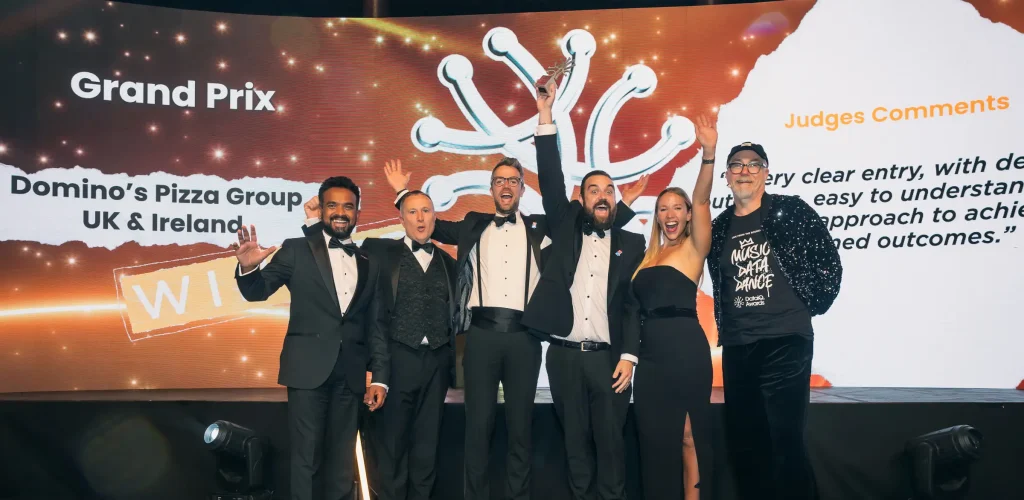
When organisations talk about AI success stories, the narrative often starts with a top-down strategy, a significant budget, and a dedicated programme team. The story behind Domi Vision at Domino’s Pizza Group UK & Ireland is different.
The initiative that won both the Breakthrough with Data or AI category and the Grand Prix at the 2026 DataIQ Awards began with the simple question of “could technology help Domino’s consistently measure pizza quality at a scale that humans never could?”
The answer became a computer vision platform that, since launch, has:
- Assessed more than 7.5 million pizzas.
- Improved product quality by 5%.
- Fundamentally changed how quality is discussed across hundreds of stores.
But the technology is only part of why judges scored the submission so highly. The complete story is how Domino’s solved one of the biggest challenges facing data leaders today: turning an AI model into something people genuinely trust, adopt, and use.
Starting with a Business Problem, Not an AI Ambition
One of the recurring themes emerging from leading organisations at DataIQ events is that successful AI programmes rarely begin with the technology itself. Domi Vision encapsulates that principle almost by accident.
Embedded within the operations function, Oliver Few, Senior Data Science Manager at Domino’s had direct visibility of the challenges franchisees faced every day. Rather than being detached from the business, Domino’s deliberately places analysts and data specialists inside operational teams, giving them a deep understanding of priorities, pressures, and opportunities.
The Domi Vision idea emerged from personal experience, a colleague receiving a pizza that didn’t meet the usual high-quality standards, not a strategic mandate: “As a customer myself, I’m thinking, ‘I can fix it,’” said Oliver.
What followed was a simple proof of concept built around existing in-store camera infrastructure, with the system focused on assessing the pizzas, not the people making them. Rather than investing in new hardware or reaching for GenAI, Oliver and the team applied traditional machine learning to a clearly defined operational challenge. Ultimately, that choice would prove crucial.
Antony Bradshaw, Director of Data and Insights, Domino’s, explained the team focused on answering: “What’s the problem you’re trying to solve? What are you trying to fix? How do I use AI to fix it? What is the problem? And can AI help me solve that problem?”
In an era where organisations are still searching for compelling AI use cases, Domino’s focused on solving a tangible business issue first and was rewarded for doing so.
Building With People, For People
Domi Vision succeeded because franchisees were involved from the beginning, a stage where many technology projects fail because stakeholders are consulted too late.
After demonstrating that the model could identify pizzas and perform basic quality assessments, the Domino’s team didn’t retreat into technical development but worked directly with franchisees to ensure the technology accurately reflected the quality expectations in stores.
Roundness, topping distribution, crust consistency, bubbles in the dough: these metrics were not defined by data scientists alone. They were shaped through ongoing collaboration with the people responsible for making and selling pizzas every day.
Oliver described the process as highly iterative: “It came from our idea, the franchisees liked the potential, then we proved the art of the possible and worked with them to grow it.”
That collaborative approach extended throughout development.
“It wasn’t just us data professionals sat in a dark corner doing this. It was franchisees and the ops teams all scoring pizzas, giving Oliver feedback, giving the adjustments and alterations that needed to happen,” explained Antony.
For many data leaders, this may be the most important lesson from the project. The AI was developed alongside users rather than being treated as a finished product that was presented to them.
Pausing Made Success Happen Faster
The project’s most impressive achievement is arguably what happened when adoption became a reality. As the platform moved closer to rollout, franchise partners rightly asked how quality insights would be used, and wanted clarity on governance, ownership, and trust.
Rather than forcing adoption, Domino’s paused. The team listened, worked through concerns, and fundamentally changed the rollout approach. Franchisees were given opportunities to interrogate the system, challenge outputs, and understand exactly how data would be handled. Adoption became voluntary through an opt-in model that remains in place today.
Those same franchise partners ultimately became advocates and active users of the platform.
For Antony, this trust-building phase was central to everything that followed: “Getting the franchisees in early, making sure they were comfortable with it, making sure it was something that they believed in meant that they could then target themselves against it.”
Domino’s has proven that adoption is earned through participation, not mandates.
Why the Impact Arrived Quickly
Once franchisees embraced the platform, behavioural change followed rapidly. One early participant was given access during the Christmas trading period before the official launch and their response surprised the team behind the model.
“I came into a chain of e-mails saying ‘please keep this going. We love it. We’ve got targets in our stores. This is now in our culture’,” recalled Oliver.
Quality improvements appeared almost immediately, with customer-related metrics beginning to shift within a matter of weeks.
Importantly, the technology itself was not the direct cause. The breakthrough came because franchisees trusted the outputs enough to change behaviour. New targets were set that were suitable for each franchise, their teams became engaged, conversations changed, and quality became measurable at a scale that had previously been impossible.
Store teams began sharing examples of exceptional pizzas, which developed into good-humoured internal competitions, leading to recognition programmes developing organically, and, ultimately, quality became part of the culture rather than an audit exercise.
“We delivered the mechanism, but it is the stores and the people that are making it as good and as successful as it actually is,” said Oliver.
How DataIQ Helped Shape the Journey
While Domi Vision is unique, Domino’s did not develop it in isolation. Both Oliver and Antony highlighted the value of the DataIQ community.
They attributed part of their success to ongoing conversations with peers. No organisation had built an identical solution, but the DataIQ community provided Domino’s practical lessons about adoption, trust, governance, and organisational change.
Antony pointed to discussions around data products, strategy, governance, and stakeholder advocacy: “The conversations taught us to question how do you ensure that you’ve got the advocates for the thing that you’re attempting to build? How do you make sure that what you’re developing is impactful to the business and prioritising those types of things has been massively useful?”
DataIQ conversations around governance and data quality informed Domino’s thinking about how information should be managed, trusted, and used for decision-making.
The organisation invested heavily in data literacy, helping franchisees understand the metrics and insights being generated, recognising that value only emerges when people can confidently interpret and act on data.
“The biggest thing for me was the ability to learn a lot from challenges that other people had seen,” said Anthony. “Hearing what worked was great, but it’s business specific. We learn from what didn’t work and what are the themes that you can take from that to learn how that works.”
That mindset mirrors the philosophy behind Domi Vision: continuous improvement driven by feedback.
Why the Judges Awarded the Grand Prix
The numbers from the award submission for Domi Vision are impressive and stood out amongst nearly 400 submissions:
- More than 7.5 million pizzas scored.
- Deployment across 800 stores.
- A 5% improvement in product quality.
The judges recognised a programme that tackled a genuine business challenge, used technology appropriately, demonstrated measurable outcomes, and delivered meaningful cultural change.
The judges’ comments described the initiative as: “A brilliant, triumphant entry that captures the true spirit of a breakthrough.”
That combination ultimately earned the highest score awarded by DataIQ judges this decade. For Antony, the nature of the peer-reviewed judging process made the achievement particularly meaningful.
“The fact that the awards are peer reviewed… there were some excellent entries in there and it’s very humbling to have the highest score this decade.”
A Blueprint for Practical AI
Perhaps the most important aspect of Domi Vision is what it says about the future of AI. The project did not begin with a large budget, it did not require thousands of employees, and it did not depend on the latest AI trend. It started with a defined problem, deep business understanding, and people willing to build something useful.
As Oliver reflected: “For me, what makes this unique, is it was ‘ground up’.”
What followed was a transformation that touched technology, operations, culture, and customer experience.
For organisations still searching for AI value, the lesson worth taking away is that the highest-scoring DataIQ Awards submission this decade was not built around AI for AI’s sake, but was built around solving a real problem, earning trust, and helping people perform better. Everything else followed.